Landlords and blind cords: what to check in a rented home, and a fix that needs no drilling
Most blind cord advice is written for parents. In a rented home, though, the parent did not choose the blinds. RoSPA's guidance is direct about where that leaves things: “If you're renting, your landlord should take responsibility for making sure any blinds in the property are safe.” This guide is the landlord's side of that sentence. (If you are the tenant, our renting guide covers the rules from your end.)
The case that put rented homes on the record
In 2022 an assistant coroner in Manchester North issued a prevention of future deaths report after Kane Davidson died in a privately rented home managed by a letting agent. The blinds had been in place “for many years” before the family moved in, had not been assessed for risk before the letting, and did not meet BS EN 13120, the standard for blinds where young children are likely to be present. The coroner noted that the landlord stays personally liable “notwithstanding the use of any intermediary letting agency”.
In its response, Oldham Council made blind cord safety a condition of its selective licences and briefed its enforcement officers to check blind cords at every property they visit. The government chose awareness over a new law for rentals. Either way, the lesson for a landlord is simple: nobody had looked.
What to check at each changeover and inspection
- Every window, not just the bedrooms. Note any loop of cord or chain that hangs within a child's reach. RoSPA puts cleats at least 1.5 m from the floor, which is a fair line to measure against.
- Whether a safety device is fitted, and still working. A tensioner that has come off the wall, or a cleat nobody uses, is no protection.
- Roman blinds. Their hazard is the cords inside the back of the blind, which no chain fitting fixes; see Roman blinds and inner cords.
- Furniture near windows. A bed or cot under a window brings a cord in reach that would otherwise be out of it.
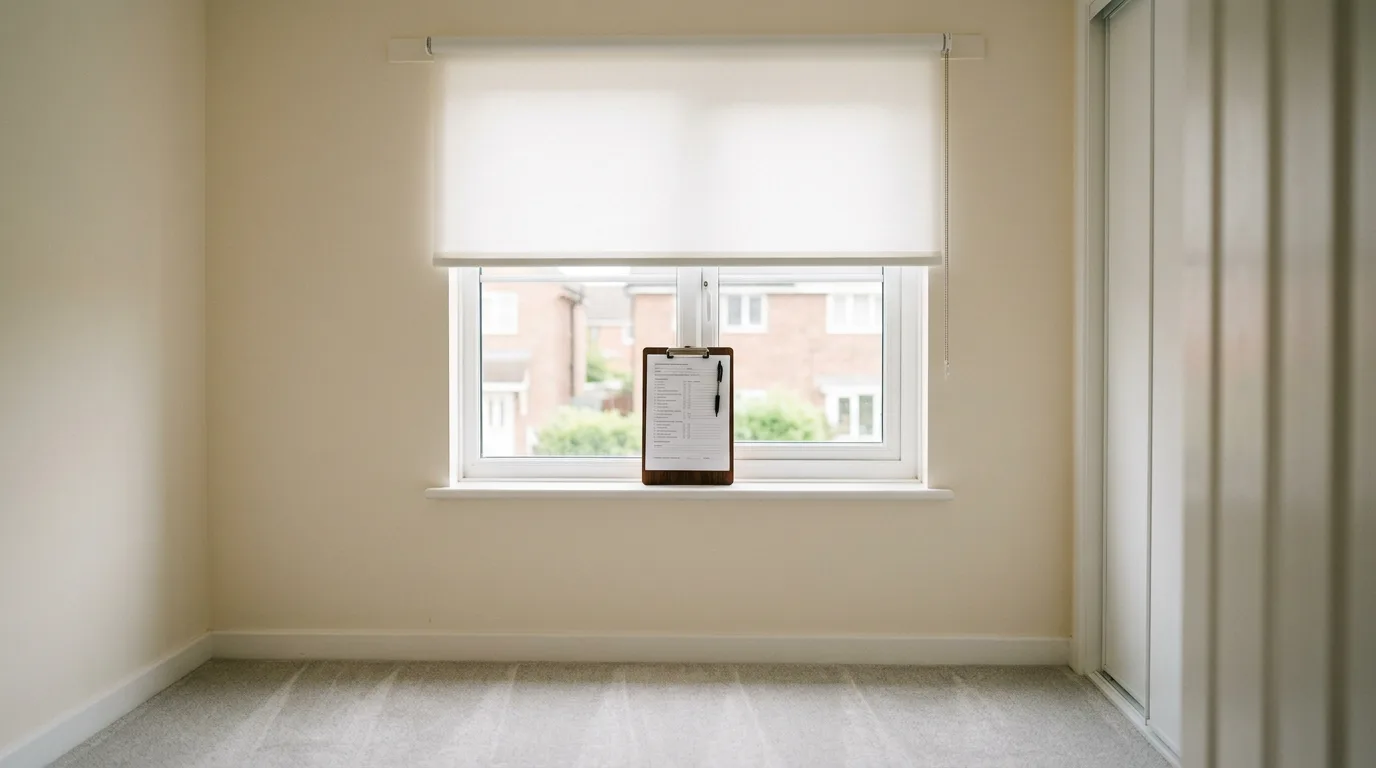
Write the result into the inventory or inspection report, with a photo of each window. If a tenant tells you a baby is on the way, or reports a loose chain, treat it as a repair to arrange promptly, not a note for next year.
Choosing a fix by blind type
- Replacing a blind anyway? RoSPA's advice is to consider a cordless model.
- Roller or vertical blind with a continuous chain: a tensioner fixed to the wall, or a winder that takes the chain up out of reach.
- Cords on a cleat: fine if the cleat is high and the tenant winds the cord every time, which is the weak point. See why cleats and tensioners are not foolproof.
- Not cutting. RoSPA is explicit: “Don't cut cords or chains – this won't remove the risk and may damage your blind.” More in winder vs cutting vs a breakaway connector.
Why no-drill suits a let
A stick-on fix can go up during an inspection in a couple of minutes, leaves no holes to make good at check-out, and is something a tenant can fit without asking permission. The honest limit is the wall: an adhesive pad needs sound, painted plaster or another smooth surface, and on woodchip or flaking paint a screw fixing is the better answer. Where to fit a winder has the detail. For short-stay property, see holiday lets and blind cords.
Managing several properties? Email [email protected] and tell us how many windows you have in mind.